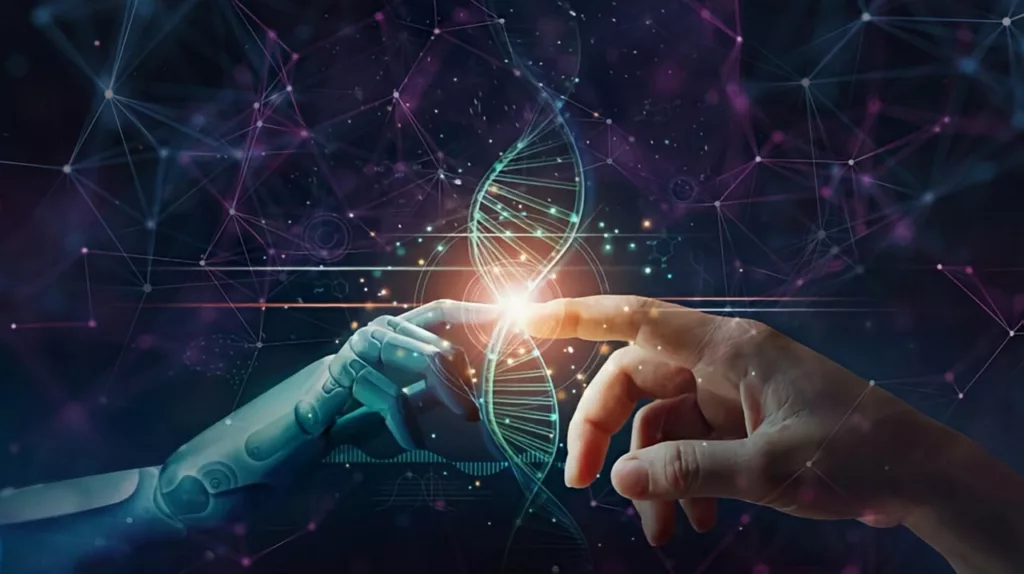

by Marta Koblańska, July 26, 18:10, Photo: DNA, author TyliJura, Pixabay
The relationship between the male sex code and the female body is unclear. However, a virtual degradation leads to a selective advantage, though this may be misleading, according to a study conducted by Austrian scientists.
Sex determinants, namely the X and Y chromosomes, emerge from the process of mitosis, which involves the division of genetic material in a cell’s nucleus at an average speed of approximately 8 hours. If this process occurs too quickly or too slowly, it can disrupt vital bodily cycles; nonetheless, sometimes such changes are necessary (i.e., during cancer treatment).
Where does the sex code begin?
The Austrian researchers confirm that the initial step in the evolution of sex chromosomes involves an autosome acquiring a sex-determining gene. This finding challenges the previous understanding that autosomes are solely responsible for the majority of an organism’s traits, excluding those related to sex.
Next comes recombination, a process that results in the loss of certain features and functions, while the sex-determining chromosomes gain others. This occurs during meiosis. For example, the male Y chromosome pairs with the originally female X chromosome, losing some of its length while accumulating fewer deleterious mutations. This may provide certain advantages and enrich its function. However, the process is entirely random, and the outcomes can be unpredictable, meaning some luck is involved. Fortunately, recombination helps protect against extensive gene loss (degradation), while its suppression prevents mistakes during the pairing of chromosomes (XY) and reduces the potential for errors.
Do disappearing traits make adaptation more difficult?
Austrian scientists state that while the emergence of proto-sex chromosomes and the degeneration of Y chromosomes are relatively well understood, the reasons for the suppression of recombination between the X and Y chromosomes remain largely speculative. Unfortunately, one explanation for this phenomenon is that alleles (gene variants) that benefit one sex, specifically males in this case, can be harmful to the other sex. Conversely, the stronger the association between the male sex determinant and its expression within the genetic code, the less likely it is to be expressed in females. Additionally, scientists claim that mutations arising on a Y chromosome can theoretically lead to inversions on the X chromosome, which also suppress X-Y recombination when present in males.
What is the primary conclusion of the study? According to the authors, no harm should be expected between the sexes when selection is sex-specific but not sexually antagonistic. In other words, if the gene versions on sex chromosomes carry sex-characteristic traits but do not negatively affect the determinants of the opposite sex, then there should be no detrimental impact. This applies as long as the chromosomes do not act against each other, aside from acquiring sex-typical features.
In the case of male sex, the process is linked to a reduction in chromosome size, which is necessary to avoid disadvantageous mutations. As a result, male sex can be considered weaker in this context. However, a scenario can arise where the male sex determination system includes both the male-determining gene and an allele that benefits males but negatively impacts females. This is advantageous because the harmful effects will not be expressed in females due to a phenomenon known as positive selection, which promotes beneficial traits. Interestingly, all chromosomes within a population may carry some harmful mutations, but the occurrence of these mutations can vary, with some chromosomes carrying more than others by chance.
The study was published in “Trends in Ecology & Evolution” with the title “Sex chromosome evolution in action in fourspine sticklebacks.”
Leave a Reply