
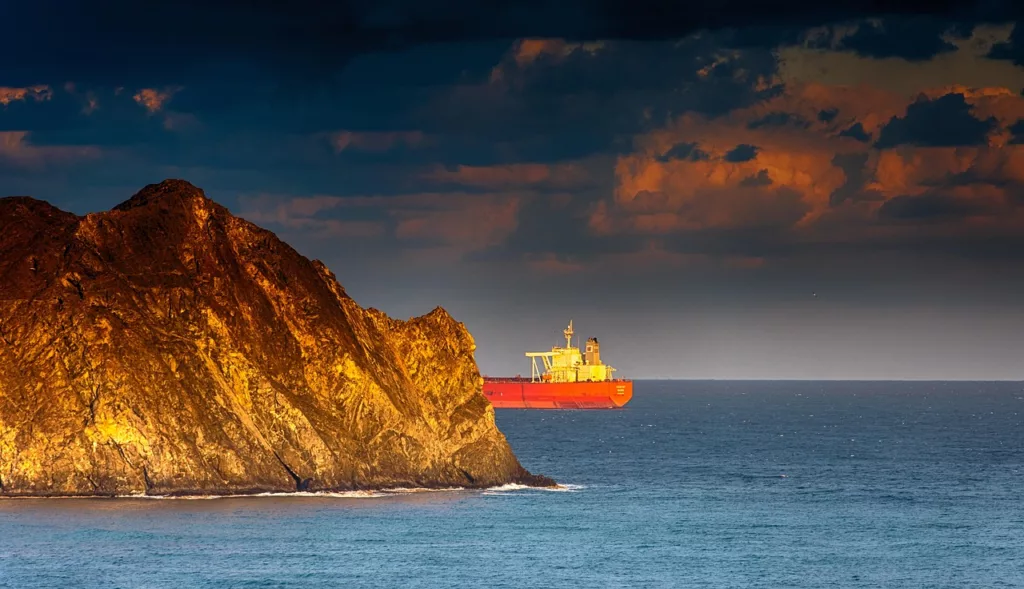
By Marta Koblanska, August 12, 17:20 Poland ‘s time, Photo: Ship, thanks to jpeter2, Pixabay
A territorial swap for the lives of Ukrainians is becoming increasingly likely, despite Ukraine’s leader initially rejecting any land concessions. Canada’s recent decision to reduce the price cap on Russian oil by approximately 20 percent has reshaped the negotiations but may be viewed as a boundary condition.
The oil market shaped up after the Second World War, and no past or potential changes in its structure so far have touched the core in terms of its rules. (One cook while everybody wants to eat). Some changes in trading can be seen, such as the Indian basket launch. More expensive than others (approximately by 5-7 percent) because no one could steal the oil destined for India. Whether it works or not, Indians should be asked; nevertheless, sometimes a higher price enables getting more volumes, and anyway, it is compensated in fuel sales. Europe, particularly Germany, has become keen on purchasing Indian fuels since the onset of the war in Ukraine.
Canada’s oil represents one of the cheapest on the market, with an average 15-18 percent below the benchmark, which is Brent oil for Europe. (A very interesting story is how the Brent benchmark was constituted, which dates back to the beginning of the 20th century.) This is because this sort of crude (Canadian) is heavy and sour due to the land’s structure from which it is extracted. That means more sophisticated, deep processing is needed (what ultimately increases the costs of fuel production) to locate the crude product on the market. Similar is with Russia’s Urals, considered by some as a heavy crude with a higher share of sulfur than, for instance, the oil from the Middle East. That keeps its price below Brent’s price, however, with a discounted transport distance. The sulfur case was one of the reasons why countries wanted to switch to more productive oil, calling the Russian one less efficient. However, as some experts emphasize, sometimes this sour oil might be much better for refineries and fuel production than the lighter one. True or not, that makes both markets strongly competitive and the war in Ukraine, although upset the trading, has not stopped it – according to reliable sources.
After the sanctions were imposed, Russia increased its share of overall oil deliveries to regions that are considered competitive with Brent and Urals. This increase occurred in areas that Brent or WTI could not fully supply, either due to production limits or high transportation costs. You might wonder how this is possible. The answer is straightforward: oil-producing countries periodically set production quotas. Typically, these countries maintain a unified stance as they have specific obligations to both themselves and the oil-importing countries. However, Russia often acts in opposition to the core OPEC members, which sometimes leads those countries to accommodate Russia’s, let’s say, requests.
And now, back to Canada, which, allegedly in cooperation with the EU and the UK, decided to cut the price limit for Russian oil by approximately. 21 percent from theoretically binding 60 dollars per barrel to 47,6 dollars per barrel transported via sea. That should, in the Canadian view, make Russian oil substantially cheaper than Canadian one and thus decrease income from oil sales on vessels for Russia.
However, according to recognized experts, tracking oil transported via sea is much more difficult than via pipes. The sea transport is also more risky and thus more expensive. Still, it is more open. Any limits raise the risk for traders who do not need to be Russians to sell Russian oil. So the question could be – Is Canada willing to eliminate competition? The country’s production costs are higher than in other parts of the world, particularly the Middle East. Nonetheless, it is feasible for Canada to sell its oil below the average global price. For Russia, which during the war in Ukraine decided not to share its extraction data, an average capex for companies can amount to approximately 10-20 dollars per barrel, depending on the field. The key here could be the quality of the extracted oil. Worse from older fields and thus with much lower production costs, and much better from the new ones with higher production costs but more efficient. One or another, that proportion may allow traders to keep the risk at an acceptable level. The risk for those operating the extraction may be higher.
How does all of this relate to Ukraine and the expressed potential territorial swap in exchange for a ceasefire and peace? Russia is not that far from Canada, but, if I may simplify, natural borders maintain the security of (a paradox) both countries. In the case of Ukraine, the location is not that advantageous. Additionally, the country’s energy balance is not in favor. The war has not improved it, as oil consumption dropped dramatically, and the most important refineries have been destroyed or damaged. Ukraine had seven refineries with overall production capacity exceeding four times Ukraine’s oil product demand. However, despite the bloody war, the country managed to maintain a relevant share of oil in the so-called energy mix, mainly for transportation and industrial use, and this could/should be included during the negotiations. Poland and Romania are key fuel suppliers, and (a paradox), this advantage comes from the Soviet Era.
Nonetheless, some may argue that the looming green transformation could be a solution for Ukraine. It was, indeed, as the US offered earlier this year a 10 percent land concession in exchange for huge investments in the new metals. That deal, if implemented, could serve as an economic guarantee from the US to Ukraine. (Sometimes much better than a virtual military guarantee, as usually the economic zone of influence is respected.) Ukraine rejected it. (To recall the Marshall Plan for Western Europe, Poland, and possibly others halted by the Soviets, with no space for discussion.) Now, when the risk for everybody seems to be substantially higher along with the Russian Army’s movements, the ongoing and, so far, unsuccessful attempts to squeeze Russian oil revenues, Ukraine’s situation might be more difficult, but still with arguments. Whether it comes to a peace or not, the Alaska meeting will show.
Leave a Reply