
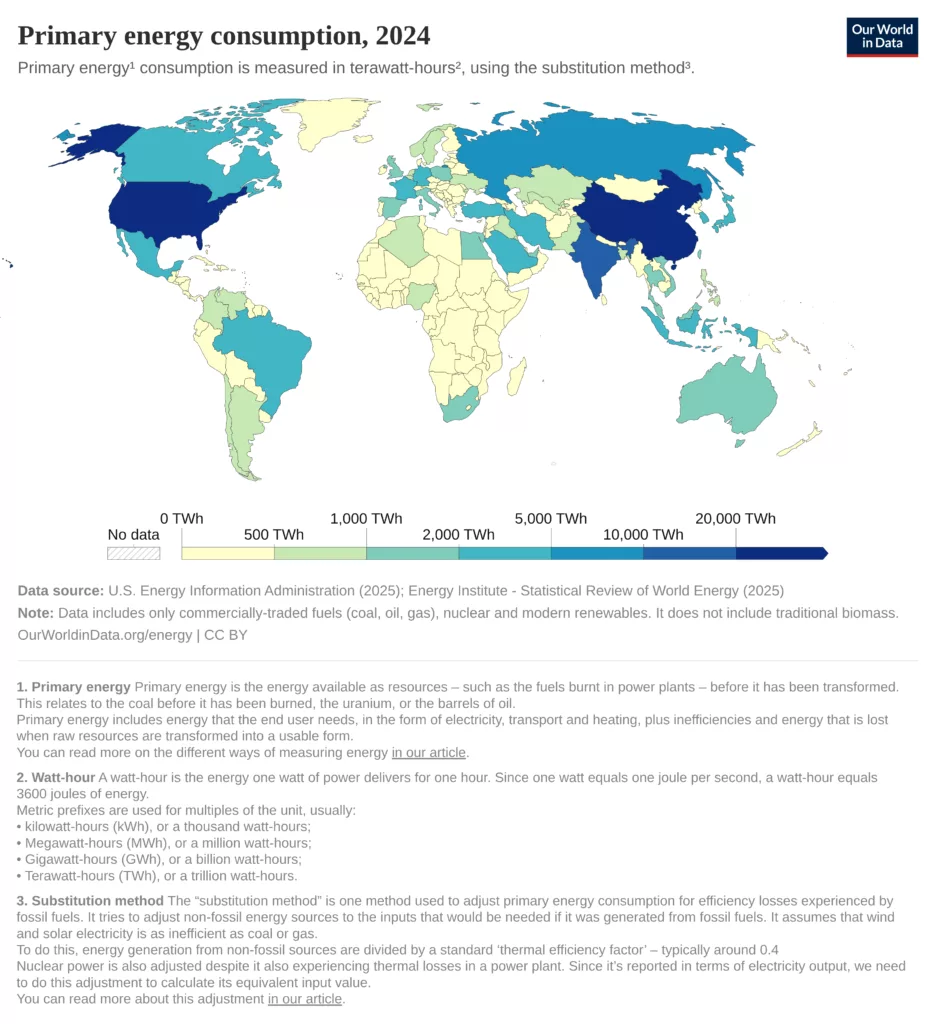
By Marta Koblanska, November 17, 2025, 13:00 Poland’s time, Photo: Primary energy consumption 2024, Energy Institute – Statistical Review of World Energy (2025), Data source: U.S. Energy Information Administration (2025)
In the coming years, the energy security of supply for importing countries will significantly rely on nuclear energy, coal, and LNG, according to the World Energy Outlook presented by the IEA on November 12, 2025.
The world currently uses about 180,000 terawatt-hours (TWh) of primary energy, with the United States, Japan, Canada, and Australia being among the top consumers. However, over the next ten years, this demand is expected to double, primarily driven by an increase in consumption in emerging markets such as China (the country accounted for approximately 50,000 TWh of primary energy consumption in 2024), India, Southeast Asia, and Latin America. In contrast, Africa is lagging behind due to limited access to clean energy, primarily relying on energy derived from agricultural waste, as highlighted during a press briefing by IEA leaders.
The rising demand for energy and electricity has to be met. And, because of the shift in transport means, as the transportation of fuel through pipelines becomes less critical due to security threats, there will be opportunities for energy sources such as nuclear and coal. At the same time, reliable suppliers and sources are becoming increasingly crucial.
– Energy security can be seen as a pivot for economic security – claimed Fatih Birol, the IEA chief. – This is why our scenarios include a strong comeback of nuclear power, increasing share of renewables, in particular solar, while we will continue to consume oil and natural gas. Nevertheless, the latter one can come in the form of LNG (liquefied natural gas feasible, for now, to transport via sea – MK’s note), changing some governments’ policy.
Demand for coal is expected to decrease by around 2030, according to Laura Cozzi. This decline may be more seasonally dependent as adjustments are made to meet current climate policy targets. However, coal continues to provide access to heat in many parts of the world.
Global energy demand is expected to be primarily driven by artificial intelligence, data centers, as well as cooling systems and electric vehicles. Approximately 40 percent of the world’s economy is dependent on just 20 percent of reliable suppliers. Additionally, 91 percent of the new rare metals that are crucial for the green transition are concentrated in a single country.
.
Leave a Reply