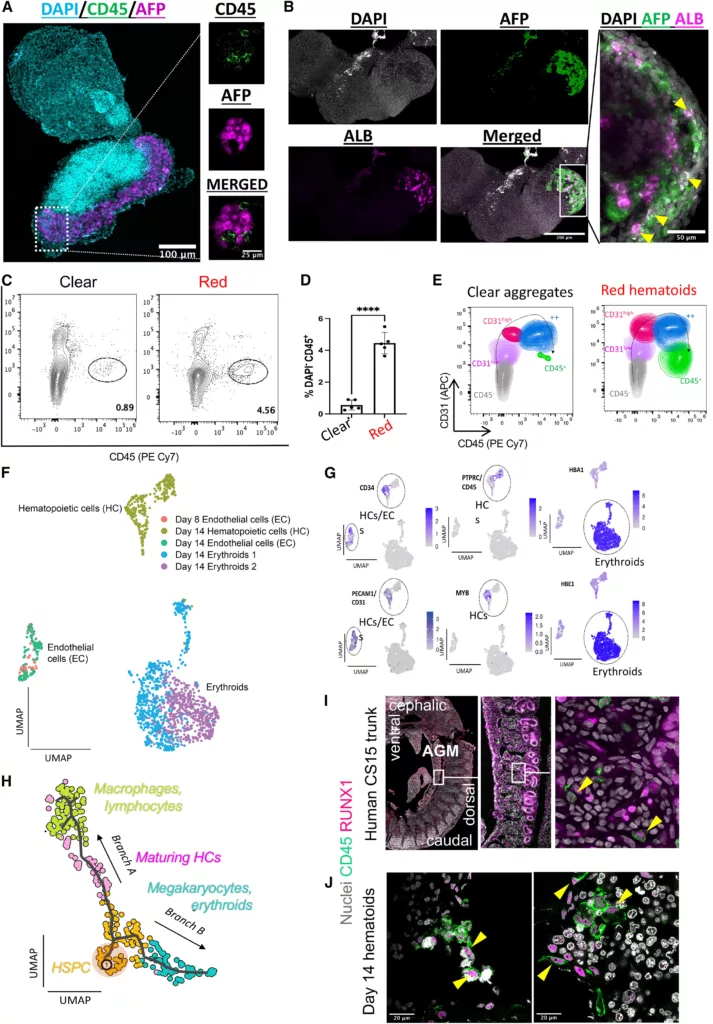
by Marta Koblanska, November 20, 2025, Photo: Double-positive cells undergoing transition in the human embryo (top), authors, Elsevier Inc
Where is the boundary between protecting life and sustaining life? A new study led by UK researchers suggests that this boundary may be found in the yolk sac tissue.
Yolk-sac tissue, allegedly deriving from or differentiating into blood stem cells in later evolutionary stages, can be seen as a hallmark of life. Why? Because it is present in all the living organisms with sexual reproduction, or those that initiate such a reproduction. This is why we will not find a yolk sac in viruses or bacteria; however, its marks appear within species at the earliest evolutionary stages, accounting for millions of years. What’s striking the appearance includes organisms without shaped up/grown up a well-developed blood system.
When we trace back the sex reproduction pathways of species, we can be astonished by their variety and forms, as well as occurring changes in, let’s say, sex identification or sex dimorphism attributes. Nevertheless, the key hallmarks remain, although both the RNA and DNA structures and sequences, along with anatomical changes significantly modified (enhanced or halted) in either species or the way of their development, leaving, though, quite tough to cross lines or boundaries.
Where does life take place?
Scientists based in the UK in a study titled: ,,A post-implantation model of human embryo development includes a definitive hematopoietic niche,” published recently in a journal,,Cell Reports” wish to go further. In line with the study description, after implantation of an embryo into the endometrium (the endothelium tissue of the womb, which conditions the next developmental stages to occur and pass – MK’s note), there was no yolk-sac tissue in vitro within the cells used in the experiment. The scientists admit, however, that it has been observed that one cluster of blood progenitors at D8 (the developmental stage of an embryo – MK’s note) and two clusters of blood progenitors at D14. Moreover, according to the researchers, ,, the transcriptional evidence ( the alligement of blood progenitors which, in line with the experiment’s description, can either stick to the endomethrium or to blood cells) suggests that hematopoiesis (the process of emergence and differentiation of blood cells) was occurring spontaneously in our model after D8—in the absence of a yolk sac tissue—and without any supplementation of hematopoiesis-associated cytokines or growth factors” – write M. Azim Surami, Adam James Reid, Sabine Dietmann, Ankit Varma, Baojiang Wu, Geraldine M. Jowett, Jitesh Neupane of the University of Cambridge, UK, Washington University School of Medicine in St. Louis, St. Louis, MO, USA, and Inner Mongolia University, Hohhot, China.
– This finding is particularly intriguing and represents the most significant phenotype in this system. Consequently, we refer to these post-implantation structures that capture hematopoietic lineages – underline researchers, while, as they state in the study, ,,the key goal is to understand the development of long-lived definitive human stem cells, which can generate mature cells for research and therapeutic use.
The focus is specifically on the progenitors of cells that later develop into liver and blood cells, as they may share a similar origin. However, scientists note that these progenitor cells cannot be classified as belonging to the yolk sac, although there may be additional tissue of this type present.
Is the potential for life regarded as valuable as mature life?
Whether it is or it is not, those cells, dependently on the developmental stage of an embryo, which include pre- and post-implantation stages, represent a sort of base for the next phases of evolution. Within the post-implantation stages, the most important is gastrulation, which occurs, in an ideal model of development, after successful connection of an embryo to the endometrial tissue in the womb (or for research purposes in the laboratory, as this is the case in this study). Usually, this is possible when a yolk sac has grown. Later, this constitutes a base for the development of the placenta, which, if efficient, conditions further stages of advance/evolution (according to some experts, human embryo development somehow recalls evolutionary stages of species).
– Currently, we lack a complete understanding of early human embryonic HSC (hematopoietic stem cells, the potential to differentiate into myeloid and lymphoid lineages and thus into further, specialized cells, systems and organs – MK’s note) development, which occurs through endothelial-to-hematopoietic transition in the aorta-gonad-mesonephros (AGM) around CS14 and possibly at other sites, write scientists.
Authors of the paper highlight that the proposed model, termed hematoids, serves as both a flexible tool for exploring tissue-scale mechanisms of human development and a potential source of human hematopoietic stem cells (HSCs) for mechanistic research and cell therapies.
The study involving human embryonic stem cells (hESCs) was approved by the Human Biology Research Ethics Committee at the University of Cambridge, UK.

Leave a Reply to scatterna Cancel reply