
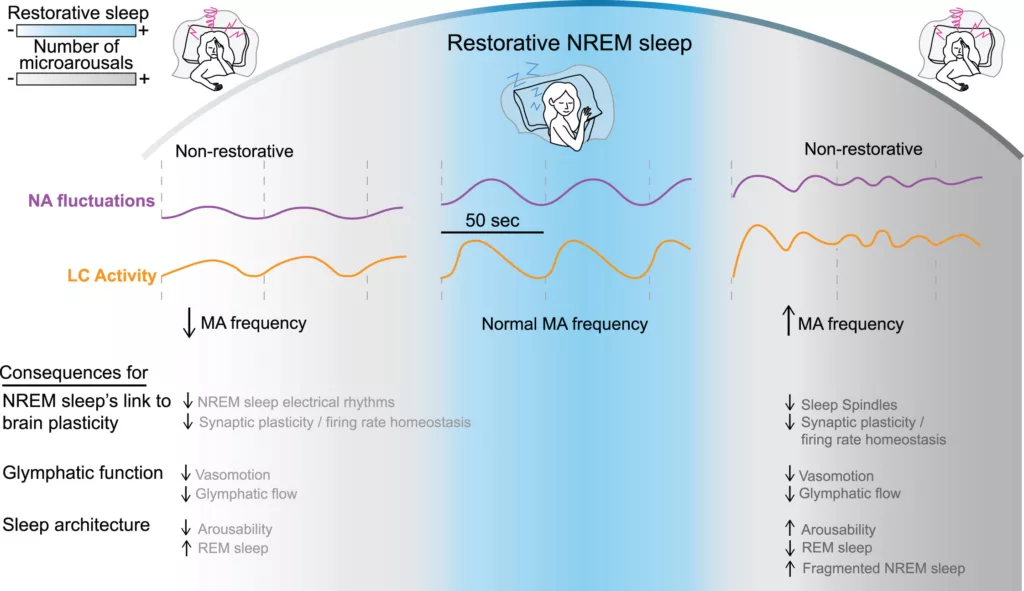
By Marta Koblańska, February 21, 2025 Photo: This model suggests that the physiological processes influenced by fluctuations in norepinephrine (NA) during NREM sleep—particularly those related to memory consolidation and glymphatic clearance—function best when these fluctuations occur approximately every 50 seconds. Authors: Anita Lüthi, Maiken Nedergaard.
Sleeping is a kind of disengagement from the environment to restore energy released earlier. Fragmented sleep harms cognition and health. At the same time, seconds of a wake-like state due to noradrenaline inflows leave us ready to wake up.
It is obvious that sleep is crucial for our daily life, memory, and cognition, as well as strengthens resilience against disease, including mental disorders and age-related neurodegeneration. Good sleep enables long-term well-being. Its disruption leads to various problems, while the reasons for commonly shared insomnia may differ individually, despite the lesion of pathways being similar, as mammalian sleep patterns seem to resemble the same key marks. These are brain waves, the amount of oxygen in the blood, the speed of the heart and breath, eyes, and limb movements. But now, scientists of Switzerland and Denmark in a new study,,Anything but small: Microarousals stand at the crossroad between noradrenaline signaling and key sleep functions, “ published in ,, Neuron” demonstrate connections between wake-like brain activity, changes in the heart and respiration, and movements of various body parts. Simultaneously, wake-like brain activity lasting seconds and corresponding body movements do not imply that microarousals are simply sleep-disrupting events.
Are we going away and back?
Our heart is separate from the brain system of signals; however, both of them work synchronously, being part (in the case of brain-selected structures) of the sympathetic system in the body. The system is responsible for, in general, action excluding the intestinal tract. The trigger to enable action is noradrenaline, a hormone that accelerates heart speed and thus blood pressure at the same time releasing glucose stored in cells, which gives an energy boost.
– With the example of rodents, we indicated natural sleep arousal events timed to fluctuations in neuromodulatory tone, particularly noradrenergic signaling driven by the locus coeruleus (LC), say Anita Lüthi of the University of Lausanne and Maiken Nedergaard of the University of Copenhagen and Rochester.
The locus coeruleus is located in the brainstem. The brain trunk represents the most primordial part of our brain that sustains basic life functions. According to the scientists, a key focus will be embedding microarousals within both sleep’s electrical rhythms and sleep-related vasomotor and glymphatic activities, revealing the microarousals as boosters for the interplay across physiology of sleep.
Surprisingly, microarousals in humans are scored when there is an EEG frequency shift (changes in brain waves) either alone or accompanied by increases in heart rate and/or muscle tone, according to the scientists. They add that in the human phase of REM sleep, a microarousal is scored once brain desynchronization coincides with electromyogram (EMG) activity. The latter is widely used in medicine to check muscle work as well as the transmission of impulses in nerves.
A neurotransmitter for going back?
Simplifying it means the key is the timely noradrenaline transmitter fluctuations during healthy sleep, causing a brief wake-like state. The booster may signal a shift in the frequencies of brain waves measured with EEG. However, the shift may also appear without microarousal as the heart rhythm can accelerate in a graded manner even without brief wake-like, and then the lighter change in EEG is caught. At the same time, as claim scientists, there are phasic EEG events that do not correspond to an EEG activation, yet they are related to an arousal process. That example is, as stated by the scientists, the K-complex. In human sleep EEG, it is a singular, large, slow wave with a biphasic waveform lasting 0.5–1 s, which can appear without apparent cause but also in response to sensory stimulation. It is accompanied by heart rate increases. But, in general, microarousals are the strongest among other waking-like processes.
Brief wakes are not the same as fragmented sleep. However, the frequency of their occurrence may differ by age and sex. The highest ratio has been observed in adult men. Along with aging, the number of microarousals may increase by 1,5 fold. The scientists emphasize that deviation from these mean values is diagnostically valuable in diverse sleep disorders.
Leave a Reply