
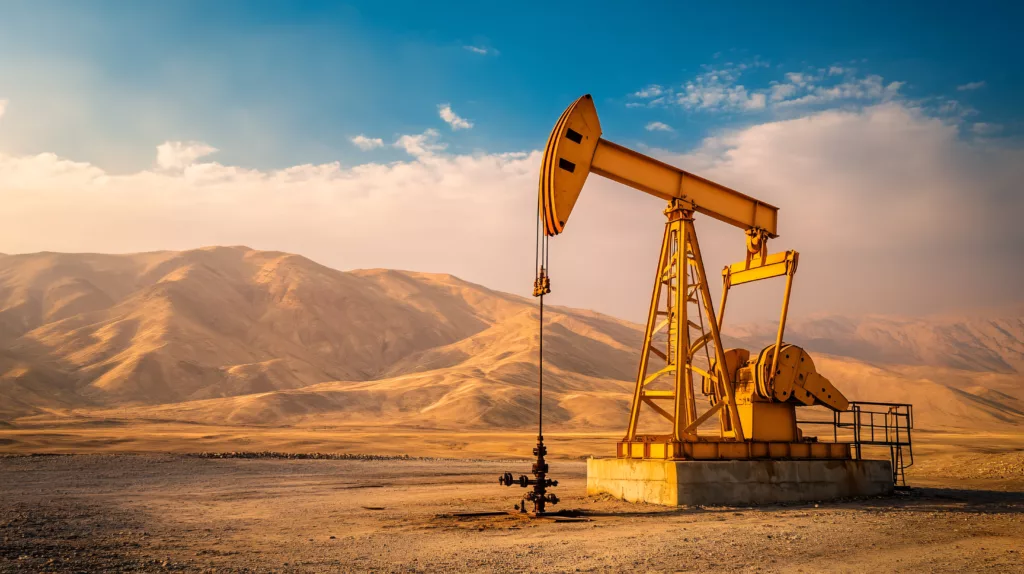
By Marta Koblanska, April 27, 2026, 12:00 Poland’s time, Photo: pumping oil, thanks to TyliJura, Pixabay
The more oil you have, the less water you drink. Conversely, the more water you need, the better your weapon becomes, unless your technology does not require that much water – a piece of the story about the war with Iran.
The US President Donald Trump is struggling to convince the world that his stance against Iran is right and the measures he has undertaken are justified. The major argument includes the nuclear power Iran can possess, along with the enrichment of uranium, the key ingredient for both energy and weapon production. The next or the first oil comes as the prices surge in regions where America would rather seek, if not support, at least understanding. Unexpectedly for some, in line with the mostly binding church message, the Pope turned out to be an ignoramus in foreign policy, leaving the space just for the one leader, self-proclaimed – Donald Trump.
Fighting against Iran is tough, as is fighting against Israel, although the latter represents Western values in the Middle East. In the past, many armies attempted to conquer the cradle of philosophy, home to one of the greatest philosophers ever – Zarathustra. None of them succeeded. And now, as Iran is fighting for the dignity of the whole Islamic World, where sometimes you can have an impression, it is not clear who is shooting at whom and why, Israel, backed by the US, is fighting exactly about the same. The balance is complicated and often not clear for most of the audience, including the author of this analysis.
The Israeli state began in 1948 with a colossal effort of the Israeli people whose survival throughout World War Second was a miracle. They were not warmly welcomed by the Arabian countries, which continuously rubbed their nose in it. However, Arabs were not wholly aware of the Israeli fate during World War II. Paradox, but the only state which was aware of the situation was Iran, which decided to help, as well as, unfortunately, that might have also been Palestine. Israel had to hear vows to push them back into the sea, and this is how the Middle East conflict originally started. Someone eventually said stop and let the Israeli stay. The country could have been Saudi Arabia after confirmation that the long-standing so-called gossip spreading around about the Gehenna of the Israeli people was true.
Recently, the bilateral talks between Israel and Lebanon started with a hope for a firm solution between one country digging out another. The images from Lebanon are not very nice, still not so touchy, as those from Palestine. But, stunning, Lebanon could be crucial to achieving peace in the Middle East and may play a significant role in resolving the Palestinian issue, especially if Israel halts its bombings. It’s important to note that US-Iran negotiations are largely independent of the situation involving Lebanon and Hezbollah. However, reaching a resolution may require substantial concessions that may not be well-received by Israel’s neighbouring countries. Unfortunately, after targeting a water distillation facility in Kuwait, Israel may adopt an even firmer stance.
Back to Iran and its uranium enrichment programme, I would suggest carefully checking what the key components of the process are. The more of them Iran needs, the less is left for others. Anyway, this is not a major problem. The main problem is that, anytime after Arabic countries, Israel, and Iran manage to secure their water needs, someone is all of a sudden leaving the club and starts to jeopardise the quotas with the arguments – we need a bit more. Another scenario involves the fact of digging long horizontal tunnels deep underground, which, due to the geological structure of the land in many parts of the Middle East, often contaminates drinking water or causes it to disappear. For those who are interested, why is oil production in the Middle East the cheapest in the world? Due to the land structure, the reservoirs are easily accessible to the surface/stretch what makes oil and gas very easy to extract. However, as natural gas requires water for production and water is more valuable in the Middle East than oil, the method of oil extraction there had to be changed or was supposed to be changed. Except for Iran in terms of the geological land structure, which, although it has to be more focused on getting out the fossils, secures the most valuable fuel for some economic sectors, with jet and marine fuel as the leaders. So, both straits’ blockades would be a real disaster not only for the oil-importing countries but also for the leading troublemakers, the US, first of all.
Iran, which in some sense subsidised Western markets by not charging the oil transporting vessels for passing through Hormuz, now starts to require tolls. And in the view of the author of this writing, it is justified, no matter what the US and the rest are thinking. In these oil-crossing fees, as well as the programme of Iranian uranium enrichment, there could be seen many premises of the fragile-suspended conflict. Whether Iran should have a nuclear weapon or not, while officially around 10 countries in the world have about 13 thousand nuclear missiles, according to reports, is an open question. In 2022, the treaty against the spread of nuclear weapons was ratified by a total of 66 countries. The US and Russia can have about 4.5 thousand 100-kiloton missiles, while India and Pakistan have around 500 each. However, bringing Iran to the leverage does not represent anyone’s interest. The US, although continuously the strongest and leading superpower (check what currency is strengthening short-term, not matter if oil price goes up or down, especially when a military conflict is looming, anyway the other one seen as most firm can stabilize medium-term due to, let’s say, more modern fuels structure) promised recently not to use nuclear weapons against Iran. Whether this time it is true, as not so long ago a couple of the heaviest bombers were deceptively directed toward the Middle East, the compromise will of the sides can show.
Disclaimer: This analysis reflects only the author’s perspective. For professional insights, please consult the relevant experts.
Leave a Reply